

Guide
Indian wedding functions, in order
The main Indian wedding functions in their usual order, from roka to reception: what happens at each, who is invited and what guests want to know beforehand.
An Indian wedding is usually several functions over several days, and names and order differ by region and community. This is a common order for a North Indian wedding, with notes on what guests need to know for each. Your family's customs come first.
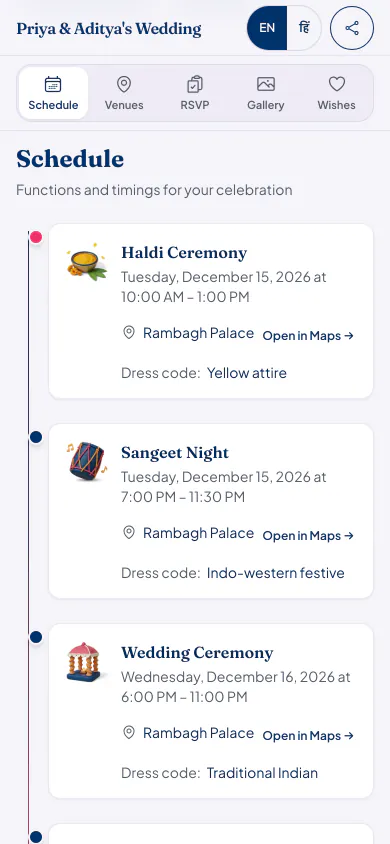
Planning the functions
Agree the list between families
Which functions are shared, which are hosted by each side, and who pays for what. This decides everything else.
Fix dates and venues
Morning functions need early starts, and some need a hard floor or open air. Allow travel time between venues.
Decide who comes to what
Many families keep the early functions small and open the reception to everyone.
Tell guests once, in one place
Dress codes, timings and maps are what guests ask about most. Put them where guests can find them again.
The functions, in the usual order
- Roka: the families agree to the match, often weeks or months ahead. A small gathering with close family.
- Engagement (sagai or ring ceremony): the couple exchange rings. It can be intimate or a full party.
- Tilak: the bride's family visits the groom's side and marks his forehead, with blessings and gifts. Mostly close male relatives in many families, though customs vary.
- Mehndi: henna for the bride, and for any guest who wants it. Usually a relaxed afternoon, with food and music.
- Haldi: turmeric paste applied to the bride or groom, often on the morning of the wedding or the day before. Guests wear clothes they do not mind staining.
- Sangeet: an evening of music and dancing, with performances from both families.
- Wedding: the ceremony itself, with the baraat, the varmala and the pheras, at a time often set by the muhurat.
- Reception: a dinner hosted after the ceremony, usually with the longest guest list of all.
What guests want to know for each
- The start time, and whether it really starts then.
- The venue, with a map link, and whether there is parking.
- What to wear, especially for the haldi and sangeet.
- Whether food is served, and whether they are expected at this function at all.
Who this helps
Couples planning a first family wedding, and working out what happens when.
Guests from another region or country who are going to their first Indian wedding.
Hosts writing their schedule, who want to explain each function to guests.
Questions about the functions
What is the order of functions in an Indian wedding?
A common North Indian order is roka, engagement, tilak, mehndi, haldi, sangeet, wedding and reception. Names and order vary by region and community, and many families combine or skip some.
How many days does an Indian wedding take?
Often two to four days for the main functions, with the roka and engagement earlier. Smaller weddings may fit it all in a day or two.
Are guests invited to all the functions?
Not always. Many families keep the roka, haldi and mehndi to close family and friends, and invite everyone to the wedding and the reception. The invitation should make it clear.
Do I need a separate invitation for each function?
No. Many families now share one link with every function on it, and limit the smaller ones to chosen guests.
What it costs
Every plan has every feature on this page. Plans differ in how many guests and photos they fit. Prices are per celebration, in rupees.
Starter
Free first year
Up to 50 guests
then ₹499 for each extra year
Classic
₹14,999 one-time
Up to 400 guests
then ₹1,499 for each extra year
Grand
₹29,999 one-time
Unlimited guests (fair use)
then ₹2,999 for each extra year
Hosts can also run everything from the Android app. Get the app
A guide to each function


Read next


Put all your functions on one link
Your page can be live in minutes. Then share one link on WhatsApp.